Building · 02

Nobody owns whole-deal integration status. I am building the system that does.
polarais.com →Build the system that gets a holding company and the companies it acquires to an agreed end state on an agreed timeline, with every stakeholder on both sides seeing the same plan, the same dependencies, and what each decision costs.
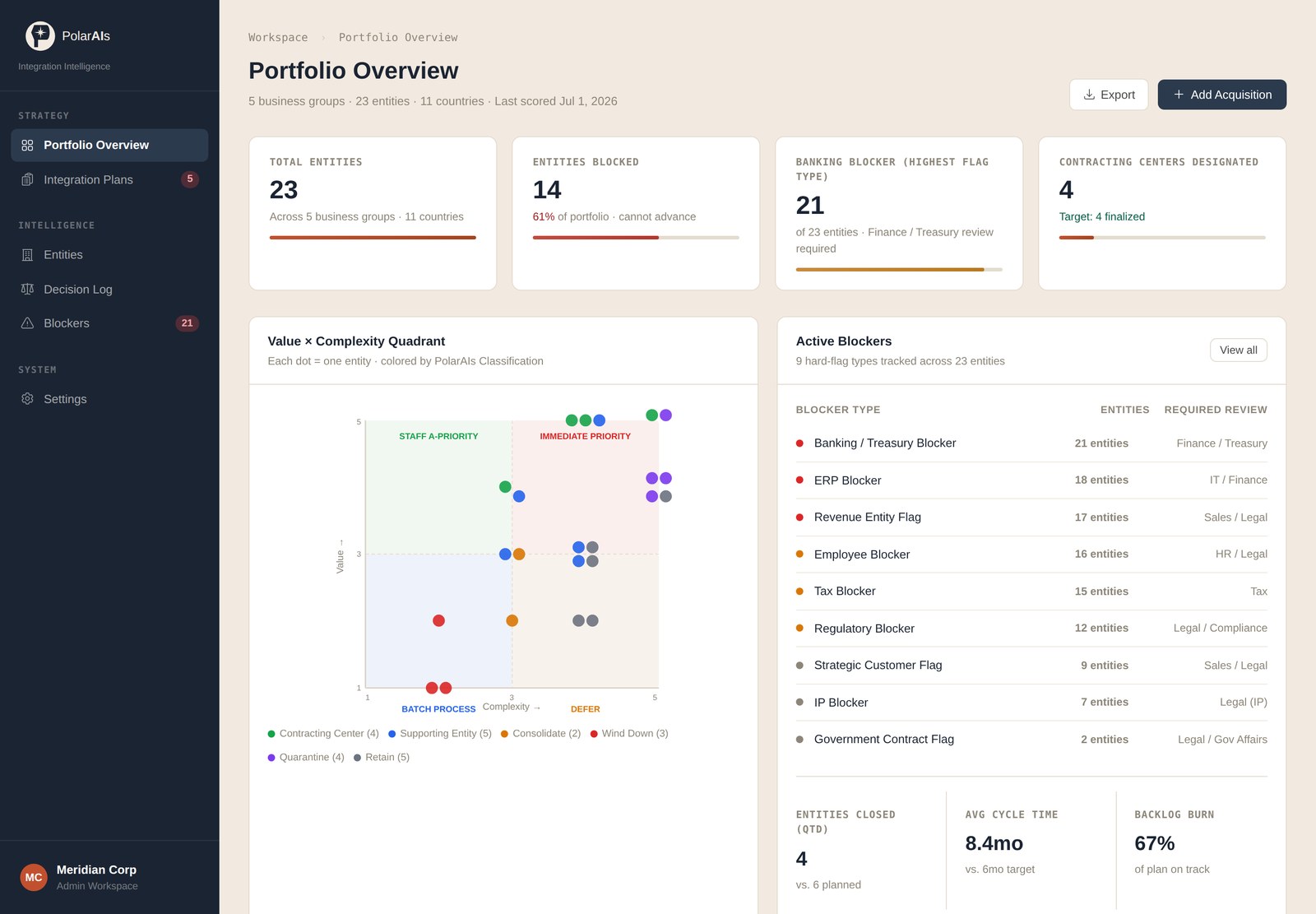
Portfolio overview, one of five live prototypes — one clickable screen per layer: Intake, entity decision card, ITTT blueprint, execution and governance, and portfolio overview. Twenty-three entities across five business groups and eleven countries, fourteen of them blocked and unable to advance, with every blocker typed and routed to the function that has to clear it. Entities and figures are illustrative.
Two decision systems, each built for a different company, forced to fuse under a clock and against a valuation. The mismatch a growing company hides over years is exposed in months.
PolarAIs is an AI-enabled operating system for M&A integration. Integration is where a chronic problem becomes an emergency, which is exactly why it is the place to solve it: the pain is sharp, the stakes are explicit, and a budget already exists.
The problem
A good process still cannot see across departments
This is the most repeated finding across twenty discovery interviews, current through August 24, 2026. Departments run in parallel off their own assumptions, standing meetings substitute for a shared view, and the deal never reaches a portfolio-level definition of done.
It is not simply a process failure. One serial acquirer in the set had built department-level diligence checklists, discovery question sets and functional playbooks, a more mature process than most of the companies interviewed, and still could not see across departments in real time. A well-resourced process fails without a live shared view.
What discovery changed
Three findings I did not expect
01
The root cause sits before close
Diligence and the synergy case are where the end state is set or lost. Business urgency routinely overrides governance in that window, and the integration inherits the gap rather than creating it.
02
Two people arrived at the answer on their own
Asked what single tool would ease the pain, before hearing anything about PolarAIs, two interviewees independently named real-time cross-functional visibility into what is being tackled and in what order. Unprompted convergence is worth more than agreement after a pitch, and I score it that way.
03
The economic buyer keeps checking out
The CFO is the obvious budget holder and is repeatedly not in the room. That is a live problem with the go-to-market rather than the product, it is unresolved, and it is recorded rather than argued away.
The system
Organize first, then intelligence is worth something
A decision system gets rebuilt in a deliberate order. Each step is useless without the one before it.
Intake
Every entity enters as a structured fingerprint — one authoritative picture of what the combined company is made of, rather than assembled from a data room.
Decision intelligence
Weighted scoring and entity readiness rules produce one classification per entity, computed the same way every time, so sequencing is arithmetic rather than politics.
ITTT + AI
A deterministic rules engine reads each entity's flags and scores and scopes exactly the workstreams and dependencies it needs, so hidden blockers become visible and routed to the function that has to clear them.
Execution & governance
Workflow orchestrated so ownership and throughput rise instead of stalling in handoffs between functions, hard-flag dependencies gate closure, and every decision is recorded so institutional knowledge compounds instead of walking out the door with the people who made it.
The Barycenter Engine is designed to be a live, continuously recalculating model of the target legal-entity structure — the end state fixed as a center of gravity the whole system moves toward, with the cost of getting there attached. It is only trustworthy because the four layers before it exist. You cannot layer reliable intelligence on disorganized data, however capable the model.
Two kinds of AI
Scoring is a decision. The summary is a convenience.
They do not deserve the same trust, and the system is built to keep them separate.
The scoring engine
Deterministic
Weighted scoring, entity readiness, and hard-flag rules, computed the same way every run, auditable back to the data that produced the number. Nothing about it is generated.
The AI layer
Generative
Drafts summaries and surfaces patterns a person reviews before anything moves. It never writes to the record on its own. That is a standing design position, not a feature still being built.
Where it stands
Five live prototypes, no platform yet
Five live prototypes are built, one clickable screen per layer: Intake, entity decision card, ITTT blueprint, execution and governance, and portfolio overview. Twenty discovery interviews are logged and scored against a standing evidence bar as of August 24, 2026, nine of them high signal. Founder and owner.
The gaps in that sample are written down rather than smoothed over: private equity portfolio operations is barely covered, one-time acquirers are thinner still, and three of the strongest interviews are three seats at the same company. The same evidence discipline made me retire a claim I had made with too much confidence: that nobody in the market designs a target end state. Pritchett has published an Integration End State Vision framework for years with a paying audience already; what is missing is software that generates a priced, entity-level version of it from the data, not the concept itself. I made the call on that evidence: close the gaps before writing platform code, not after. Discovery is paused. The prototypes and the scored interviews stay on file.
The drift-detection job that keeps the scoring honest was built into the architecture before a single customer's data existed, rather than found missing after launch. The same discipline is visible in Alice.
Companies outgrow their decision systems before they outgrow their markets.
Contact
If you have an integration coming, or one that went sideways, tell me where it stands.
msandfordboone@gmail.comI will tell you within a day whether I am the right person, including when I am not.
Last updated September 2026